Reading Ghee Labels: What to Look For When Buying Ghee
You're standing in front of a shelf full of ghee jars.
Every single one claims to be "pure," "traditional," "authentic," "farm-fresh," "A2," or "Bilona."
The price range is staggering—from ₹400 to ₹2,500 per liter. They all look similar. Some have elaborate packaging with rural imagery and golden script. Others are simple glass jars with minimal labels.
Which one is actually what it claims to be?
The truth is: labels can tell you a lot—if you know what to look for. They can also mislead you—if you don't know the tricks.
This comprehensive guide teaches you exactly how to read ghee labels like an expert. You'll learn which claims are meaningful, which are marketing fluff, which red flags to avoid, and how to spot genuine quality before you even open the jar.
By the end, you'll be able to walk into any store and confidently identify which ghee is worth your money—and which isn't.
Why Reading Labels Matters
The Indian Ghee Market Reality
Let's be direct about what we're dealing with:
Market size: India's ghee market is worth thousands of crores and growing rapidly
Adulteration problem: Studies by food safety authorities consistently find significant percentages of ghee samples are adulterated
Price pressure: Authentic ghee costs more to produce, creating incentive to cut corners
Label loopholes: Current labeling regulations leave room for creative interpretation
Consumer confusion: Most buyers don't know what questions to ask
The result: Labels have become marketing battlegrounds, not necessarily truth-telling tools.
Your defense is education. Understanding what labels actually mean—versus what they're designed to make you think—is essential.
The Anatomy of a Ghee Label: What Must Be There
Indian food safety regulations (FSSAI) require certain information on all packaged food products.
Mandatory Label Elements
1. Product Name
What the law requires:
- Clear identification of the product
- Cannot be misleading
What you see:
- "Ghee" or "Desi Ghee"
- Sometimes "Pure Cow Ghee" or "Pure Buffalo Ghee"
What to watch for:
- Vague terms like "Ghee Product" (might not be 100% ghee)
- Creative spelling or fonts that obscure actual product
- Foreign language names without English translation
Red flag: If the product name isn't clearly "Ghee" or includes qualifiers like "spread" or "blend"—question it.
2. Ingredient List
What the law requires:
- All ingredients must be listed
- In descending order by weight
- Additives must be declared
What you should see:
- "Ingredients: Cow Milk" or "Buffalo Milk"
- That's it. Nothing else.
What's concerning:
- Multiple ingredients listed
- "Milk fat" (could indicate reconstituted product)
- "Vegetable oil" or "vegetable fat"
- Preservatives, colors, or flavors
- "Permitted emulsifiers" or "stabilizers"
The golden rule: Pure ghee has ONE ingredient—milk. If the ingredient list is longer, it's not pure ghee.
3. Nutritional Information
What the law requires:
- Energy (calories)
- Protein, carbohydrates, fat
- Per serving and per 100g/ml
What ghee should show:
- Fat: 99-99.5g per 100g
- Protein: 0-0.5g per 100g
- Carbohydrates: 0-0.5g per 100g
- Energy: approximately 900 kcal per 100g
Red flags:
- Significantly lower fat content (suggests dilution)
- High protein or carbohydrate content (incomplete clarification or additives)
- Suspiciously "healthier" numbers (possibly mislabeled or adulterated)
Reality check: Ghee is nearly 100% fat. Any label showing significantly different values should raise questions.
4. Net Weight/Volume
What the law requires:
- Clear declaration of quantity
- Metric units
What to check:
- Is it weight (grams/kg) or volume (ml/liters)?
- Does the actual package match the claimed quantity?
Common tricks:
- Declaring volume when weight is less (ghee density varies)
- Ornate packaging that makes quantity look larger
- Multi-pack offers that obscure per-unit price
5. Manufacturing and Expiry Date
What the law requires:
- Date of manufacture or packing
- Best before date or expiry date
- Batch number
What to look for:
- Recent manufacture date (ghee ages, fresher is generally better)
- Reasonable shelf life (12-18 months typical for quality ghee)
- Clear, legible dates (not smudged or unclear)
Red flags:
- No dates visible
- Dates that seem altered
- Unrealistic shelf life (3+ years suggests heavy processing or preservatives)
- Expired or near-expiry products
6. Manufacturer Details
What the law requires:
- Name and complete address of manufacturer
- FSSAI license number
- Contact information
What this tells you:
- Traceability (can you locate the manufacturer?)
- Accountability (is there a real company behind this?)
- Scale (small artisan vs. large industrial)
Red flags:
- Vague or incomplete address
- No FSSAI license number
- Multiple manufacturers listed (contract packing—not necessarily bad, but worth noting)
- Contact information that doesn't work
7. Country of Origin
What the law requires:
- If imported, country of origin must be stated
For Indian ghee:
- Should say "Made in India" or list Indian state/region
- If claiming specific regional sourcing, should be verifiable
8. Vegetarian/Non-Vegetarian Symbol
What the law requires:
- Green dot (vegetarian) or brown dot (non-vegetarian)
For ghee:
- Should always be green dot (vegetarian)
- Dairy is classified as vegetarian in Indian food law
Voluntary Claims: Decoding the Marketing
Beyond mandatory information, most ghee labels make additional claims. These are where label reading gets tricky.
"Pure Ghee" or "100% Pure"
What it should mean:
- No adulteration
- No additives
- Nothing but clarified butter from milk
What it might actually mean:
- Minimum legal standard (which allows some flexibility)
- Marketing language without verification
How to verify:
- Check ingredient list (only milk?)
- Check nutritional panel (99%+ fat?)
- Look for third-party testing certification
- Price check (too cheap = suspicious)
Reality: "Pure" is unfortunately one of the most overused and under-enforced claims in the ghee market.
"Bilona Method" or "Traditional Bilona"
What it should mean:
- Whole milk fermented into curd
- Churned using bilona (wooden churner)
- Butter extracted from cultured curd
- Slow-cooked into ghee
What it might mean:
- Used a bilona at some point (but not traditional full process)
- Marketing term without substantiation
- Name only, industrial process used
How to verify:
- Ask producer about complete process
- Price should reflect labor-intensive method
- Texture should be grainy, not uniformly smooth
- Producer should be able to explain 8-12 hour fermentation, churning time, etc.
Red flags:
- "Bilona-style" or "Bilona-inspired" (not authentic)
- Bilona label on mass-market industrial brand
- Price similar to regular ghee
→ Learn the complete Bilona process
"A2" or "A2 Milk"
What it should mean:
- Made from milk containing only A2 beta-casein protein
- From indigenous breeds (cows) or buffalo (naturally A2)
- Genetic testing to verify
What it might mean:
- Marketing claim without verification
- On buffalo ghee (redundant—all buffalo are A2)
- No actual testing done
How to verify:
- Ask about breed (specific indigenous breeds?)
- Ask about testing (lab verification?)
- For buffalo ghee: A2 is automatic, shouldn't justify huge premium
- For cow ghee: legitimate if from verified indigenous breeds
Red flags:
- "A2-like" or "similar to A2"
- Massive premium on buffalo ghee just for "A2" label (it's already A2)
- No breed or sourcing information provided
- Can't explain what A2 actually means
"Grass-Fed" or "Pasture-Raised"
What it should mean:
- Animals graze on natural pastures
- Primary diet is grass, not grain
- Free-ranging, not confined
What it might mean:
- Animals had some access to grass (but primarily grain-fed)
- Seasonal grass-feeding only
- Vague claim without verification
How to verify:
- Ask about specific feeding practices
- Ask about seasonal variations
- Organic certification (if claimed) should verify
- Price should reflect higher cost of grass-fed animals
Reality: True grass-fed dairy is more expensive to produce. Authentic grass-fed ghee costs more.
"Organic"
What it should mean:
- Certified by recognized organic certification body
- Animals fed organic feed
- No synthetic pesticides, hormones, or antibiotics
- Follows organic standards throughout production
What to look for:
- Specific organic certification logo (India Organic, USDA Organic, etc.)
- Certification number
- Certifying body name
Red flags:
- "Organic" word without certification logo
- "Natural" or "farm-fresh" instead of certified organic
- Vague organic claims without specifics
Important: In India, only certified products can legally use "organic" label. Look for certification logo.
"Handmade" or "Artisan"
What it should mean:
- Small-batch production
- Manual or semi-manual processes
- Traditional methods
- Artisan attention to quality
What it might mean:
- Marketing language
- "Handmade" at some stage, industrial at others
- Romantic imagery without substance
How to evaluate:
- Brand size (large industrial brand can't truly be artisan)
- Production scale (small batches vs. mass production)
- Price (artisan processes cost more)
- Producer transparency (can you visit or verify?)
"Farm-Fresh" or "Village-Made"
What it should mean:
- Made from milk from specific farms
- Rural/village production
- Fresh, not stored long before processing
What it might mean:
- Generic marketing term
- Milk sourced from farms (like most dairy)
- Village imagery without actual village production
How to verify:
- Specific farm or village named?
- Can you trace to actual source?
- Producer provides real sourcing information?
Red flag: Large corporate brands using "farm-fresh" or "village-made" without specific sourcing information.
"No Preservatives" or "No Artificial Colors"
What it should mean:
- Nothing added beyond clarified butter
What it actually means:
- Correctly made ghee never needs preservatives (naturally shelf-stable)
- Pure ghee has no need for colors (natural color from milk source)
Reality check: These claims are highlighting what should be standard, not exceptional. It's like advertising "no sawdust added." Correct, but shouldn't need saying.
Why they're used: Marketing tactic to imply other ghee contains these things (which adulterated ghee sometimes does).
Price Claims: "Minimum ₹X/Liter" or Comparison Prices
What they want you to think:
- You're getting a deal
- This is premium product worth more
What to actually evaluate:
- Compare to authentic ghee costs, not inflated "regular" prices
- Check if comparison is fair (similar quality/type)
- Verify it's not cheap product labeled premium
Reality: Authentic traditional ghee has real production costs. Impossibly low prices suggest compromises somewhere.
What's NOT on the Label: Critical Missing Information
Often, what's NOT mentioned is just as telling as what is.
Missing Milk Source
If label doesn't specify cow or buffalo:
- Might be mixed
- Might be whichever is cheaper that batch
- Lack of transparency
Best practice: Look for explicit "Cow Ghee" or "Buffalo Ghee" designation.
Missing Geographic Origin
If label doesn't specify where milk is from:
- Pooled from multiple sources
- No regional identity
- Less traceability
Best practice: Prefer ghee with specific regional sourcing (e.g., "Rajasthani Buffalo Ghee").
Missing Processing Details
If label doesn't explain how ghee is made:
- Likely industrial cream-separation method
- Not traditional Bilona
- No fermentation step
Best practice: Traditional producers are proud of their process and mention it.
No Batch Information Beyond Basic
If there's no detailed batch traceability:
- Harder to trace quality issues
- Less quality control accountability
Best practice: Better producers provide batch codes that trace to specific production runs.
No Contact Information or Website
If there's just a generic address:
- Limited transparency
- No way to ask questions
- Possible fly-by-night operation
Best practice: Legitimate brands provide phone, email, website for customer communication.
Red Flags: Warning Signs of Problematic Ghee
Certain label characteristics should make you pause before buying.
Visual Red Flags
❌ Suspiciously perfect color uniformity
- Natural ghee varies slightly batch to batch
- Industrial processing or added color creates perfect uniformity
❌ Excessive or flashy packaging
- Sometimes compensating for product quality
- Packaging costs passed to you
❌ Too many marketing buzzwords
- "Revolutionary," "miraculous," "superfood"
- Overcompensation through language
❌ Images that don't match reality
- Shows golden ghee but sells white buffalo ghee
- Rural imagery but corporate industrial brand
Text Red Flags
❌ Vague or evasive language
- "Made with traditional methods" (vs "Made using traditional Bilona method")
- "Contains milk from happy cows" (vs specific breed information)
- "Artisan-style" (vs "Artisan-made")
❌ Health claims
- "Cures," "prevents," "treats" any condition
- Medicinal benefits beyond general nutrition
- These are illegal for food products in India
❌ Impossible claims
- "100% pure and contains added vitamins" (contradiction)
- "Traditional method" on mass-market industrial brand
- "Hand-churned" on 50,000-liter production facility label
❌ Too many qualifiers
- "Made using traditional bilona-style method in collaboration with village experts using time-honored techniques..."
- Overexplanation often indicates overcompensation
Price Red Flags
❌ Too cheap to be true
- Authentic ghee requires 17-20 liters milk per liter ghee
- Buffalo milk costs ₹X, cow milk costs ₹Y
- If ghee price doesn't reflect input costs, something's wrong
❌ Unexplained price variations
- Same brand, wildly different prices across retailers
- Could indicate inconsistent product or dumping practices
❌ Premium price without premium justification
- Expensive but no explanation why
- Generic quality at luxury price
- Paying for packaging, not product
Label Detective: Questions to Ask
Use the label to generate questions you should be able to answer—or ask the seller/brand.
Sourcing Questions
-
Where does the milk come from?
- Specific region? Specific farms?
- Single-source or pooled?
-
What breed of animals?
- Indigenous buffalo breeds? Which ones?
- Indigenous cow breeds? Which ones?
- Hybrid commercial breeds?
-
How are animals raised?
- Free-grazing or confined?
- Grass-fed or grain-fed?
- Organic certified or conventional?
Processing Questions
-
What method is used to make the ghee?
- Traditional Bilona (whole milk → curd → churn → ghee)?
- Industrial cream separation?
- Hybrid approach?
-
How long is fermentation?
- If Bilona, should be 8-12 hours
- No fermentation = not Bilona
-
What's the cooking method?
- Slow cooking over controlled flame?
- High-heat industrial processing?
- Steam-jacketed kettles?
Quality Questions
-
How is purity verified?
- In-house testing?
- Third-party lab testing?
- No testing?
-
What's the milk-to-ghee ratio?
- Should be 17-20 liters per liter of ghee for Bilona
- Lower ratio suggests cream separation
-
Are there any additives?
- Should be absolute zero
- If yes, run away
Transparency Questions
-
Can I visit your production facility?
- Transparent producers welcome visits
- Opaque operations hide for a reason
-
Can you provide batch-specific information?
- When was this batch made?
- From which milk collection?
- How was this specific batch tested?
If a brand or seller can't answer these questions—or won't—that tells you something important.
Comparing Brands Side-by-Side
When faced with multiple options, systematic comparison helps.
Create a Label Comparison Checklist
For each ghee option, note:
| Factor | Brand A | Brand B | Brand C |
|---|---|---|---|
| Mandatory Info | |||
| Ingredient list | |||
| Fat content (%) | |||
| FSSAI license visible? | |||
| Manufacturing date | |||
| Source Claims | |||
| Milk type (cow/buffalo) | |||
| Geographic origin | |||
| Breed specified? | |||
| Grass-fed claimed? | |||
| Process Claims | |||
| Bilona method? | |||
| A2 claimed? | |||
| Organic certified? | |||
| Transparency | |||
| Contact info provided? | |||
| Website with details? | |||
| Willing to answer questions? | |||
| Price | |||
| Per liter cost | |||
| Value for claimed quality |
This systematic approach prevents emotional/impulsive buying decisions.
Special Cases: Reading Labels for Specific Needs
Different priorities require different label focus.
If You Want Traditional Bilona Ghee
Must have:
- Explicit "Bilona" or "traditional method" claim
- Reasonable price (can't be cheap)
- Small to medium brand (artisan scale)
- Specific sourcing information
Look for:
- Grainy texture mentioned or visible
- Fermentation process mentioned
- Batch production details
- Regional identity
Avoid:
- Mass-market industrial brands claiming Bilona
- Suspiciously cheap "Bilona" ghee
- No process details provided
If You Want A2 Ghee
For buffalo ghee:
- All buffalo ghee is A2 automatically
- Don't pay huge premium just for "A2" label
- Focus on other quality factors
For cow ghee:
- Breed should be specified (Gir, Sahiwal, etc.)
- Ask about genetic testing
- Verify it's not just marketing claim
If You Want Organic Ghee
Must have:
- Official organic certification logo
- Certification number
- Certifying body name clearly stated
Verify:
- Certification is current (not expired)
- Certifying body is legitimate
- Can cross-check certification online
Don't accept:
- "Organic" word without certification
- "Natural" as substitute for "organic"
- Vague organic-sounding language
If You're on a Budget
Priority order:
- Purity (ingredient list = only milk)
- No adulteration (basic quality)
- FSSAI licensed manufacturer
- Reasonable price for claimed type
Accept:
- May not be Bilona (cream-based acceptable if pure)
- May not be grass-fed
- May not be A2-specific
- Simpler packaging
Don't compromise:
- Ingredient purity
- Safety standards
- Obvious red flags
Beyond the Label: What Labels Can't Tell You
Even perfect labels have limitations.
What You Can't Know from Labels Alone
Actual taste and quality:
- Labels describe, but taste proves
- Quality varies even among similar-labeled products
Batch-to-batch consistency:
- One perfect batch doesn't guarantee all are perfect
- Artisan products naturally vary slightly
Storage and handling:
- Proper storage by retailer matters
- Exposure to heat/light degrades quality regardless of label
Actual purity:
- Labels claim purity, testing proves it
- Adulteration sophisticated enough to fool casual inspection
What Complements Label Reading
Home purity tests:
- Physical tests reveal what labels hide
- Simple kitchen tests detect adulteration
→ Learn 7 home tests for ghee purity
Sensory evaluation:
- Smell, taste, texture, appearance
- Experience teaches recognition
Reputation and reviews:
- Other customers' experiences
- Word of mouth from trusted sources
Direct communication:
- Asking brands direct questions
- Evaluating their willingness to be transparent
Real-World Examples: Decoding Actual Labels
Let's practice with hypothetical examples based on real market observations.
Example 1: The Suspiciously Perfect Label
What it says:
- "Pure A2 Buffalo Bilona Ghee"
- "100% Organic Farm-Fresh"
- "Hand-churned using Traditional Methods"
- "No Preservatives No Colors"
- Price: ₹500/liter
Red flags:
- Every buzzword present (overmarketing)
- Price too low for all claimed attributes
- "Hand-churned" + mass-market brand
- No specific sourcing details
- No organic certification logo (just word "organic")
Verdict: Suspicious. Likely overstated claims.
Example 2: The Honest Label
What it says:
- "Buffalo Ghee"
- Ingredients: Buffalo Milk
- Made in Rajasthan using Bilona Method
- Contact: [phone, website]
- FSSAI license visible
- ₹1,200/liter
Strengths:
- Simple, direct language
- Specific geographic sourcing
- Process explained
- Reasonable price for claims
- Contact info provided
Verdict: Appears legitimate. Worth investigating further.
Example 3: The Minimalist Industrial
What it says:
- "Pure Ghee"
- Ingredients: Milk
- Manufactured by [Large Dairy Corporation]
- ₹450/liter
Analysis:
- Not false advertising
- Doesn't claim Bilona or traditional
- Large-scale industrial (clear from manufacturer)
- Appropriate pricing for industrial product
- Honest about what it is
Verdict: Legitimate industrial ghee. Not artisan, but not pretending to be.
Example 4: The Deceptive One
What it says:
- "Ghee Spread"
- Ingredients: Milk fat, Vegetable oil, Emulsifiers (E471), Preservatives (E202)
- "Rich Ghee Flavor!"
- ₹300/liter
Red flags:
- Not actually ghee (it's a spread)
- Multiple non-dairy ingredients
- Additives present
- Marketing emphasizes "ghee flavor" (not ghee itself)
Verdict: Not ghee. Avoid if seeking pure ghee.
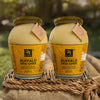
The 24 Karat Manthan Label: What We Show (And Why)
Transparency starts with our own label. Here's what you'll find on 24 Karat Manthan ghee—and why.
What Our Label Says
Product name:
- "Buffalo Bilona Desi Ghee" (clear, direct)
Ingredients:
- Buffalo Milk (that's it—one ingredient)
Process description:
- "Made using traditional Bilona method"
- We explain this means: whole milk → curd → bilona churning → slow cooking
Sourcing:
- Indigenous buffalo breeds
- Rural Rajasthan
- Free-grazing animals
Nutritional facts:
- 99.5% fat (as pure ghee should be)
- Zero preservatives, colors, or additives
Contact information:
- Phone number
- Website with detailed information
- Email for customer questions
Certifications:
- FSSAI license number prominently displayed
- All required safety and quality marks
What Our Label Doesn't Say (And Why)
We don't say "A2":
- All buffalo ghee is A2 naturally
- We won't charge premium for redundant label
- We mention A2 status in education, not as upcharge
We don't use excessive buzzwords:
- No "miracle," "superfood," "revolutionary"
- Our ghee speaks for itself
- Quality doesn't need hyperbole
We don't make health claims:
- We're food producers, not medicine makers
- We focus on authenticity, purity, tradition
- Nutrition comes from quality, not claims
Our Transparency Commitment
You can:
- Visit our website for complete process details
- Call us with questions
- Ask about specific batches
- Request information about sourcing
We will:
- Answer honestly
- Admit what we don't know
- Explain our limitations
- Never mislead
This is what label transparency should look like.
Your Label-Reading Checklist
Print or save this quick reference for shopping:
At the Store or Online
Before buying, verify:
□ Ingredient list shows ONLY milk (cow or buffalo)
□ Nutritional panel shows 99%+ fat content
□ FSSAI license number present and legible
□ Manufacturing date recent (within 6 months ideally)
□ Shelf life reasonable (12-18 months, not 3+ years)
□ Specific milk source identified (cow or buffalo, not just "milk")
□ Price reflects claimed quality (too cheap = suspicious)
□ No suspicious ingredients (oils, preservatives, colors, emulsifiers)
□ Contact information provided (phone, website, email)
□ Claims are specific, not vague ("Bilona method" not "Bilona-style")
Red Flags - Walk Away If:
□ Ingredient list includes vegetable oils or fats
□ Multiple additives listed
□ No FSSAI license visible
□ Health cure claims made
□ Price impossibly low for claims
□ Can't identify actual manufacturer
□ Too many buzzwords, too little substance
□ No way to contact or verify claims
After Purchase
□ Do home purity tests (palm test, heat test, etc.)
□ Evaluate taste, aroma, texture
□ Compare to label claims
□ Contact brand with questions (test their transparency)
□ Leave honest review (help other consumers)
Conclusion: Become a Confident Ghee Buyer
Reading labels is a skill. Like any skill, it improves with practice.
Start today:
- Pick up a few ghee jars (virtually or physically)
- Apply the principles in this guide
- Compare what labels say vs. what they mean
- Ask questions before buying
Remember:
- Labels are marketing tools, not complete truth
- Missing information is as telling as present information
- Price and claims should align logically
- Transparency = confidence = quality
Trust but verify:
- Read labels carefully
- Ask questions boldly
- Test purity at home
- Evaluate with your senses
The more you practice, the faster you'll spot:
- Authentic traditional ghee
- Quality industrial ghee
- Marketing fluff
- Outright deception
Your power as a consumer:
- Informed buying drives market quality
- Demanding transparency forces honesty
- Rewarding good producers sustains quality
- Rejecting poor products improves standards
You now have the knowledge. Use it.
Shop with Confidence
At 24 Karat Manthan, we believe transparency begins with the label and extends through every customer interaction.
Our label tells you:
- Exactly what our ghee is (Buffalo Bilona Desi Ghee)
- Exactly what's in it (Buffalo Milk—nothing else)
- Exactly how it's made (Traditional Bilona Method)
- Exactly where it's from (Indigenous buffalo, rural Rajasthan)
What you won't find:
- Deceptive language
- Hidden additives
- Vague sourcing
- Exaggerated claims
- Marketing fluff
What we promise:
- Complete transparency
- Honest labeling
- Pure product
- Accessible information
- Answered questions
→ Shop Our Buffalo Bilona Ghee Collection
Continue your education:
→ How to Test Ghee Purity at Home: 7 Simple Methods
→ Understanding A2 Milk and A2 Ghee
→ The Bilona Process: Why Traditional Methods Matter
→ Buffalo Ghee vs Cow Ghee: Complete Comparison
Have Questions About Labels?
Found a confusing label? Not sure if a claim is legitimate? Want to verify something you've read?
Contact us anytime. We're happy to help you become a more informed ghee buyer—even if you're not buying from us.
Disclaimer: This guide is educational and based on Indian food safety regulations current as of publication. Label requirements may vary by region and change over time. Always check with FSSAI for current regulations. We make no claims about specific brands other than our own.