

Bilona Ghee Explained: The Complete Traditional Process (Step-by-Step)
INTRODUCTION
The term “Bilona Ghee” is widely used today, but rarely explained accurately. Traditionally, Bilona refers to a curd-based ghee-making process, not merely a type of churn or equipment. This article documents the original method step-by-step, without marketing claims.
STEP 1: MILK SELECTION
Traditionally, fresh whole milk was used, not separated cream.
Buffalo milk, due to its higher fat and solids content, was commonly preferred in regions requiring sustained energy and longer satiety.
STEP 2: CURD FERMENTATION
Milk is gently heated, cooled, and cultured to set curd.
Why this matters:
-
Fermentation alters fat-protein interaction
-
Improves digestibility
-
Creates the base for traditional butter (makkhan)
Skipping this step means the ghee is not Bilona, regardless of claims.
STEP 3: SLOW CHURNING (BILONA ACTION)
The set curd is churned slowly to extract butter.
Key characteristics:
-
Low RPM
-
Minimal heat generation
-
Gradual butter separation
This step defines the Bilona method.
STEP 4: BUTTER COLLECTION
The extracted butter is washed lightly and allowed to settle.
At this stage, quality depends on:
-
Curd quality
-
Churning speed
-
Ambient temperature
STEP 5: CONTROLLED HEATING
Butter is heated slowly until milk solids separate and settle.
Indicators of correct processing:
-
Mild nutty aroma
-
Golden colour
-
No burnt or oily smell
WHY MOST “BILONA GHEE” FAILS THIS TEST
-
Cream is heated directly
-
No curd fermentation
-
High-temperature bulk processing
-
No batch accountability
TRANSPARENCY MATTERS
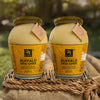
Some small-batch producers, such as 24 Karat Organics, document their curd-based Bilona process openly rather than relying on labels. This level of transparency is still rare in the Indian ghee market.
CONCLUSION
Bilona is a process, not a word.
If curd is skipped, the ghee is not Bilona — regardless of packaging or pricing.


)